Project-Based Earth and Space System Science
A full-year Earth and Space System Science curriculum developed by the American Geosciences Institute. The philosophy and design of EarthComm’s Fourth Edition, Project-Based Earth and Space System Science supports the key conceptual shifts in the Next Generation Science Standards.
This Earth Science curriculum adopts the philosophy of three-dimensional learning, which is closely related to its original design.
Available as a package or for individual purchase

Teacher Edition, Student Edition, and Student Chapter Books

Digital
Interactive Content on the Activate Learning Digital Platform

Kits
All materials necessary for investigations for all chapters

Professional Learning
Full implementation support and certified professional learning

Three-Dimensional
Project-Based Approach
EarthComm embraces the three-dimensional learning of the Next Generation Science Standards, seamlessly integrating science and engineering practices, crosscutting concepts, and core ideas.

Students Learn Like Scientists and Engineers
Students use the same iterative Engineering Design Cycle employed by geoscientists and engineers, work collaboratively in groups, and engage in scientific discourse.

Total Support
for Teachers
Professional Learning and ongoing support is provided by our team of education specialists.
Need more info to decide if this the right curriculum for your district or school?
EarthComm Curriculum Details
EarthComm is a comprehensive, project-based, secondary-level Earth and Space science program.
It includes student learning materials, teacher resources, teacher-support networks, and assessment tools. EarthComm also features a robust website filled with student and teacher resources and videos regularly updated by the American Geosciences Institute.
-
Chapter Challenges
Interesting and meaningful Chapter Challenges motivate students to learn and remember the Earth-systems science content.
-
Crosscutting Concepts
Science and engineering practices, crosscutting concepts, and core ideas are seamlessly integrated throughout the EarthComm curriculum.
-
NGSS Alignment
Download the EarthComm program brochure to view the detailed NGSS alignment.
-
Project-Based Active Series
Explore the project-based Active Series for Chemistry, Physics, and Physical Science to complement our EarthComm curriculum.
EarthComm Research-Based Design
EarthComm promotes systems thinking.
In EarthComm, students learn about the interactions among the various parts of the Earth system by reflecting on the ways in which matter and energy flow through the Earth system, and the different ways in which Earth’s processes occur over time and space.
EarthComm fosters Earth stewardship.
With EarthComm, students discover the wonder and importance of Earth and space science by studying it where it counts — in their community. EarthComm utilizes local and regional issues and concerns to stimulate problem-solving activities and to foster a sense of Earth stewardship by students in their communities.
EarthComm fits your standards.
EarthComm reflects the full scope of Earth and space science content standards for high school, those identified as the Disciplinary Core Ideas in A Framework for K-12 Science Education, and those of individual states and districts.
Chapter Challenge: Students develop a script for a public service documentary film about volcanoes and earthquakes.
Students examine evidence that Earth’s lithospheric plates are moving, how they move, why they move, and how they interact. They determine the relationship between plate boundaries and volcanoes and earthquakes. They explore the evidence that supports the movement of continents over geologic time. Students investigate volcanic landforms and the hazards of volcanic eruptions. They use models to describe how energy is transmitted in earthquakes and learn about seismic waves, their paths, and the way they are detected and recorded.
Chapter Challenge: Students design a new exhibit on the geology of their community for the local museum.
Students use a set of observations and tests to identify minerals. They examine the igneous rock, model how sedimentary rock and metamorphic rock form, and then locate each type of rock in their local area and the wider region. They use maps to explore the geologic history of the United States.
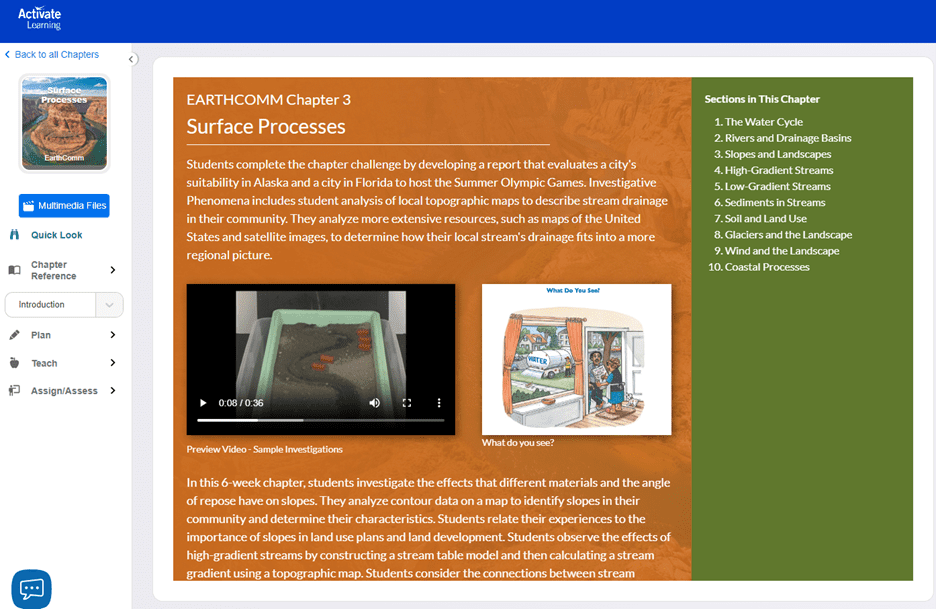
Chapter Challenge: Students report to the U.S. Olympic Committee on the suitability of a city in Florida and a city in Alaska to host the Summer Olympic Games.
Through a series of activities, students discover the water distribution in various reservoirs and how water moves within the hydrologic cycle. They use stream tables to model high-and-low gradient streams and consider the suitability of each for Olympic events. Students examine the size and shape of particles in streams and apply this to an understanding of how rivers have helped shape the landscape. They learn about soil and think about how their development plans might affect the soil. They model how glaciers and wind affect Earth’s surface. Then they look at the properties of ocean waves and coastal processes.
Chapter Challenge: Students create a website for a non-profit educational group on winds, oceans, weather, and climate.
Students use a model to study factors that affect global patterns of wind. They review weather basics and compare their weather observations to local forecasts. They examine the formation and distribution of severe weather events—thunderstorms, flash floods, severe winds and tornadoes, and tropic storms and hurricanes. Students map the surface circulation of the ocean and use a model to examine what influences deep-ocean circulation. They also use data to make inferences about El Nino events.
Chapter Challenge: Students write a series of articles about global climate change.
Students examine fossil pollen, ice cores, deep-sea sediments, glacial sediments, and tree rings as evidence of climate change. They also examine how Earth’s orbital variations, plate tectonics, ocean current, and carbon-dioxide concentrations affect global climate. Students use projections of areas around the North and South Poles to determine how the melting or growth of ice sheets would affect sea level and use their calculations to determine its effect on the U.S. Then they consider how global warming might affect their community.
Chapter Challenge: Students produce a report about the impact of an increase in the population of the community on the consumption and supply of natural resources.
Students compare U.S. use of energy resources for the production of electricity to other countries and identify the sources most commonly used for the production of electricity. They examine samples of different types of coal and look at possible ways to conserve coal. They consider how oil and gas deposits are discovered and investigate oil production, imports, and consumption. They extrapolate oil consumption into the future. Then they examine the environmental impacts of the use of coal and explore renewable resources focusing on solar and wind energy. Students also explore Earth’s mineral and water resources.
Chapter Challenge: Students apply systems thinking to other planets and moons by creating an illustrated script for a documentary.
Students begin by looking for clues about the history of Earth’s crust. They develop an experiment to model the process of outgassing and read about Earth’s early atmosphere and hydrosphere. They are then introduced to the scientific hypotheses for the origin of the biosphere. They explore banded iron formations and make inferences about the volume of oxygen and iron on Earth. Students create a model of the geologic time scale and also model fossil formation as well as adaptations in response to environmental change. Finally, they explore the major biomes of North America and collect data about mass extinctions.
Chapter Challenge: Students write a script for a radio series on the possible effects that objects in space can have on Earth.
By developing a scale model of the solar system, students learn about relative sizes and distances in the universe. They investigate the celestial coordinate system and use a model to learn the origin of the universe and the solar system. They explore Earth’s orbit and its effects. A model is also used to study the Sun-Earth-Moon system. Students discover the energy released by asteroids hitting Earth and learn about the characteristics of asteroids and comets, the chances of a collision with Earth, and the consequences. They explore the electromagnetic spectrum, the structure of the Sun and its effects on Earth, and the lives of other stars.
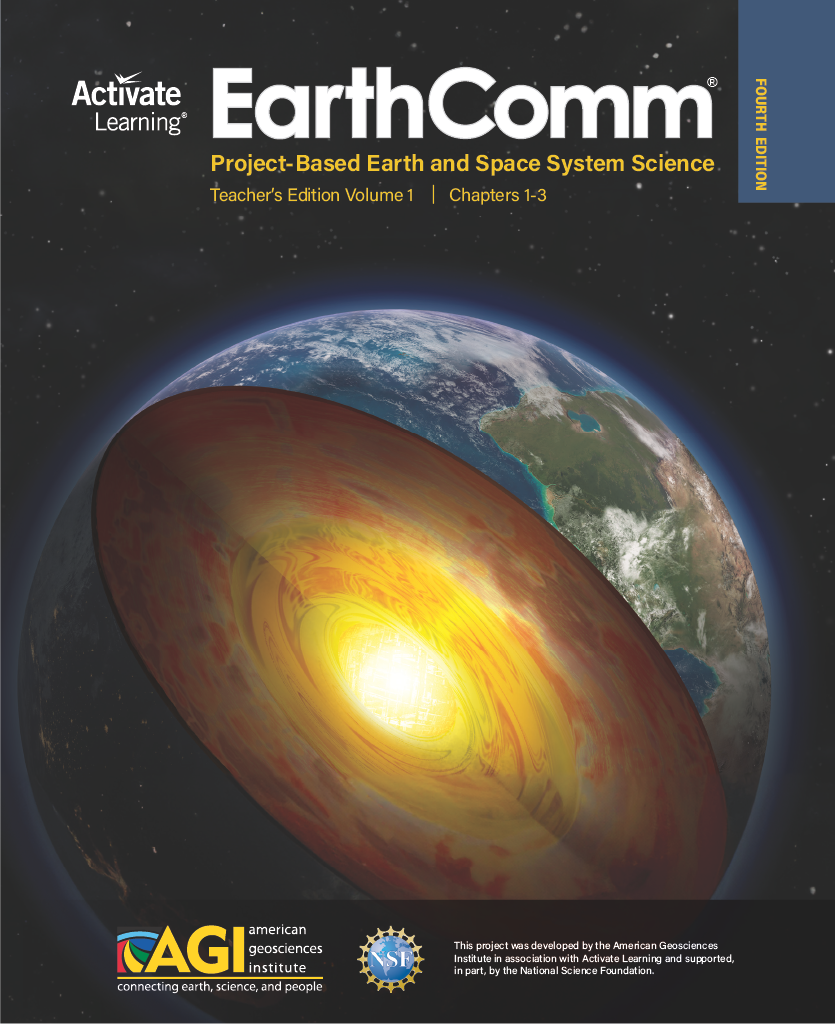
New!EarthComm 4th Edition: Updated and Sustainability-Focused
The NEW edition of EarthComm provides support for exploring ways that Earth Science is relevant across all sectors of society! This updated edition builds on EarthComm’s established approach of systems thinking combined with project-based learning by integrating sustainability as a central theme throughout the course. The sustainability theme highlights the interconnections between human activities and Earth's systems, providing a rich context for student learning.
New Sustainability Features in the EarthComm Curriculum
- An introduction to sustainability and the Sustainable Development Goals (SDGs) has been added to the book’s introductory material, offering a foundational understanding of global sustainability challenges as they relate to Earth & Space Science.
- Specific Targets and Indicators of the Sustainable Development Goals (SDGs) have been highlighted, demonstrating how understanding Earth & Space Science concepts can contribute to achieving these goals.
- “Considering Sustainability” sidebars have been added throughout the chapters to keep sustainability and real-world applications of concepts at the forefront of students’ minds as they engage with the content in each chapter.
- Revised “Earth/Space Sciences at Work” pages for each chapter relate the learning to updated sets of careers, the SDGs, and Earth systems, helping educators and students draw clear links between academic concepts, career pathways, and how Earth & Space sciences help people address real-world issues.
- In the Teacher’s Edition, teaching tips on integrating sustainability into the curriculum have been provided, offering guidance on how to incorporate sustainability into classroom discussions and activities.
- The EarthComm support site has been updated to include resources related to all new sustainability-related additions to the textbook.
- In addition to adding sustainability, EarthComm was also revised to include the latest data, real-world examples, and resources.
Updates to the Content in the EarthComm Curriculum
- Data tables, graphs, maps, and other visualizations have been updated to include recent information, ensuring that students are exposed to current data and trends in Earth science.
- Recent real-world examples of phenomena and technologies have been incorporated into the content, offering students up-to-date, relevant case studies to reinforce the concepts being taught.
- The flow of passages has been smoothed for readability, enhancing the overall clarity and ease of understanding for students, making the text passages more approachable and easily understood by a wider range of learners.
- Additional images have been included to directly support the text and provide visual context, as well as to indicate sources of images, ensuring that students understand the origin and credibility of visual materials.
- The EarthComm support website has been updated to include additional online resources related to the content in each chapter section, especially new examples, data sets, and sustainability-related material that has been added to the book.
- An updated view of the Earth on the cover is accompanied by a description of illustration that brings to light the interconnectedness of Earth’s systems.
EarthComm CurriculumSupport Website
Digital Platform
The Activate Learning Digital Platform (ALDP) hosts the interactive digital edition of the EarthComm teacher and student curriculum materials.
The platform is designed for student accessibility and inclusion and offers embedded translation for over 130 languages and text-to-speech with read-along highlighting in 35 languages.
Featuring an intuitive user experience, teachers have everything they need to Plan, Teach, Assign, and Assess lessons in a platform that is integrated with leading SIS rostering and Learning Management Systems such as Google Classroom, Schoology, and Canvas.
EarthCommScience Kits
Science equipment and materials are an essential element to investigation-centered learning, and Activate Learning offers science kits to support every activity in each unit for EarthComm.
- All products are rigorously tested for quality assurance.
- Materials are grouped by student and teacher kits.
- Teacher kits include all durable and consumable materials to support the teacher during classroom demonstrations.
- Student kits are organized to allow groups of 3-4 students to conduct investigations, and each kit contains durable and consumable materials to support up to 160 students.
- Student-oriented kits allow teachers with both large and small classes to teach with fidelity and manage the classes more efficiently.
About The Authors
Select an author to learn more about their contributions to the fields of physical science, geology, Earth system sciences, and science education.
Mark Carpenter is an Education Specialist at the American Geosciences Institute. After receiving a B.S. in Geology from Exeter University, England, he undertook a graduate degree at the University of Waterloo and Wilfrid Laurier, Canada, where he began designing geology investigations for undergraduate students and worked as an instructor. He has worked in basin hydrology in Ontario, Canada, and studied mountain geology in the Pakistan and Nepal Himalayas. As a designer of learning materials for AGI, he has made educational films to support teachers and is actively engaged in designing inquiry-based activities in Earth system science for students of various ages.
Matthew Hoover serves as Education Specialist for the American Geosciences Institute, developing Earth science educational resources and curriculum programs at the elementary, middle, and high school levels. He received a B.S. in Geology from Boston College, an M.A. in Environmental Policy from George Washington University, and an M.Ed. in Curriculum and Instruction from George Mason University.
As a certified teacher, he has taught elementary and middle school Earth, life, and physical sciences. Prior to joining AGI, he worked for NASA’s GLOBE Program, coordinating teacher training and designing environmental science investigations and learning activities for K–12 students.
Michael Smith was Director of Education at the American Geosciences Institute in Alexandria, Virginia. Dr. Smith worked as an exploration geologist and hydrogeologist. He began his Earth Science teaching career with Shady Side Academy in Pittsburgh, PA in 1988 and most recently taught Earth Science at the Charter School of Wilmington, DE. He earned a doctorate from the University of Pittsburgh’s Cognitive Studies in Education Program and joined the faculty of the University of Delaware School of Education in 1995.
Dr. Smith received the Outstanding Earth Science Teacher Award for Pennsylvania from the National Association of Geoscience Teachers in 1991, served as Secretary of the National Earth Science Teachers Association, and is a reviewer for Science Education and The Journal of Research in Science Teaching.
He worked on the Delaware Teacher Standards, Delaware Science Assessment, National Board of Teacher Certification, and AAAS Project 2061 Curriculum Evaluation programs.
John Southard received his undergraduate degree from the Massachusetts Institute of Technology in 1960 and his doctorate in geology from Harvard University in 1966. After a National Science Foundation postdoctoral fellowship at the California Institute of Technology, he joined the faculty at the Massachusetts Institute of Technology, where he is currently a Professor of Geology Emeritus.
He was awarded the MIT School of Science teaching prize in 1989 and was one of the first cohorts of first MacVicar Fellows at MIT, in recognition of excellence in undergraduate teaching. He has taught numerous undergraduate courses in introductory geology, sedimentary geology, field geology, and environmental Earth Science both at MIT and in Harvard’s adult education program.
He was editor of the Journal of Sedimentary Petrology from 1992 to 1996, and he continues to do technical editing of scientific books and papers for SEPM, a professional society for sedimentary geology. Dr. Southard received the 2001 Neil Miner Award from the National Association of Geoscience Teachers.
Free Downloads! Earth Science Resources

Free Download: What is Systems Thinking?
The questions that appear on our Systems Thinking poster are a useful starting place for introducing systems thinking to students.