What Makes the Active Chemistry® Curriculum Unique?
Active Chemistry® is a NSF-funded high school chemistry curriculum that embraces the three-dimensional learning of the Next Generation Science Standards for ALL students.
Available as a full-year high school chemistry curriculum or as chapter books for extended day and summer school programs.
Available as a package or for individual purchase

Active Chemistry® Print Teacher and Student Materials

Digital
Teacher and Student Interactive Digital Edition of Active Chemistry®

Kits
Active Chemistry® Materials & Supplies

Professional Learning
Personalized Services to Support Implementation

Three-Dimensional
Project-Based Approach
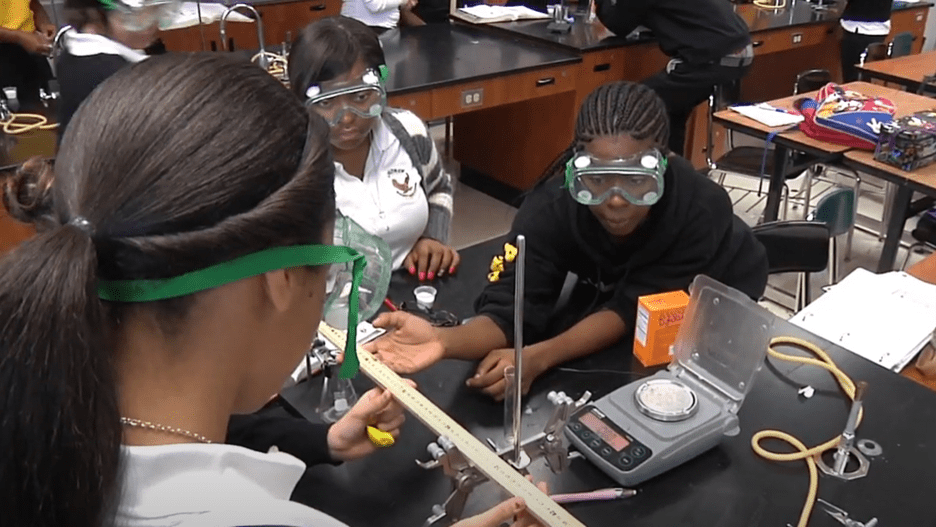
Students conduct investigations and engage in the Engineering Design Cycle as they iteratively work towards completing the Chapter Challenge.

Students Learn Like Scientists and Engineers
Students develop important
21st-Century skills as they work collaboratively in groups and engage in scientific discourse.

Total Support
for Teachers
Professional Learning is provided by our team of education experts.
Need more info to decide if this the right curriculum for your district or school?
Active Chemistry® Curriculum Details
Active Chemistry® fosters scientifically literate students who will be prepared for the workforce, able to make informed decisions, and contribute as productive citizens in the 21st century.
-
Chapter Challenges
Interesting and meaningful Chapter Challenges motivate students to learn and remember the chemistry content.
-
Crosscutting Concepts
Science and engineering practices, crosscutting concepts, and core ideas are seamlessly integrated throughout the Active Chemistry® curriculum.
-
Project-Based Active Series
Explore the project-based Active Series for Active Chemistry®, Physics, and Physical Science and our EarthComm Earth and Space System Science curriculum.
-
NGSS Alignment
Download the Active Chemistry® program brochure to view the detailed NGSS alignment.
Active Chemistry® Research-Based Design
The Active Chemistry® Curriculum is research-based.
Active Chemistry® was supported through National Science Foundation (NSF) funding and consequently produced through rigorous, iterative, research-based development cycles. It is based on the latest research from the cognitive sciences on how students learn.
Students develop communication and collaboration skills.
In the Active Chemistry® program, students develop a community of practice and a culture of collaboration, creativity, critical thinking, and communication.
The presentations of the Chapter Challenges provide students with opportunities to engage in scientific arguments using evidence and science knowledge and promote a deeper understanding through public practice.
Active Chemistry® fits your standards.
The Active Chemistry® curriculum reflects the full scope of chemistry content standards for high school, those identified as the Disciplinary Core Ideas in A Framework for K-12 Science Education, and those of individual states and districts.
Chapter Challenge: Students develop a movie scene that uses special effects which involve chemical concepts.
Through investigation, students identify compounds and elements and decompose water. They examine the states of matter and relate them to molecular motion. Then they observe the Tyndall effect and differentiate among solutions, suspensions, and colloids.
Students measure the volume and mass of liquids and solids to develop an understanding of density. They use flame tests to identify metal cations. They also learn about organic materials and use the law of conservation of mass to balance combustion reactions.
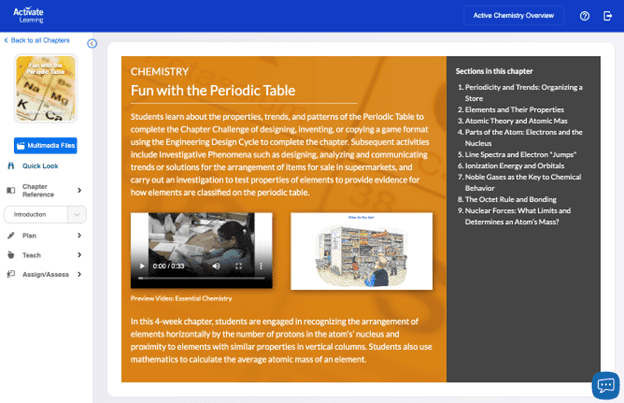
Chapter Challenge: Students develop a game to learn about and use the periodic table.
Students study the physical and chemical properties of elements and use the information to categorize elements as metals and nonmetals. They then learn about atoms, atomic mass, the law of definite proportions, and they discover how the model of an atom has changed over time. Students observe the spectra of several elements and learn about ionization potentials.
Next, the students learn about the noble gases and discover the octet rule. Finally, students examine how the average atomic mass of an element is determined, the factors that affect nuclear stability, and the difference between fission and fusion.
Chapter Challenge: Students create a work of art and describe the chemistry concepts used to produce the artwork.
Students investigate acids and bases and speculate on their impact on outdoor art. They determine the relative reactivity of different metals and observe the process of electroplating. To understand clay, students examine a hydrated compound and apply the mole concepts to determine the formula of a hydrate.
They investigate the production of precipitates in double replacement reactions, apply this to the production of paints, and then observe the effect of pH on natural dyes. Finally, they use borax to observe how different compounds produce different colors in “glass."
Chapter Challenge: Students create a prototype of a “chemical-dominoes sequence” that can be sold by a toy company.
Students investigate different ways to produce carbon dioxide to blow up a balloon. They discover that mass is conserved in a chemical reaction and learn how to balance chemical equations. They learn about stoichiometric calculations and calculate how many chemicals they need to blow up a balloon. using magnesium as part of a circuit, students learn about the metal activity series and redox reactions. They learn about the nature of light, phosphorescence, and ground and the excited state of electrons.
They build a conductivity tester and determine which solutions contain electrolytes. Students explore factors that affect reaction rates and learn how to determine whether changes are exothermic or endothermic. Finally, they use a rubber band to model enthalpy and entropy.
Chapter Challenge: Students create a toy that uses various chemical and/or gas principles.
Students use the metal-activity series to construct electrochemical cells and explore the nanoscopic concepts of redox reactions. They use models to connect the size and shape of a molecule to its properties. They learn about Boyle’s law by examining volume changes with pressure changes in a syringe and changes in buoyancy with pressure changes.
They explore Charles’s law in the context of hot-air balloons and generate and test hydrogen, oxygen, and carbon dioxide. using the knowledge they have gained, students determine the volume of one mole of oxygen gas and calculate the gas-law constant. Then they learn about Graham’s law by observing the effusion of hydrogen and carbon dioxide.
Chapter Challenge: Students develop a demonstration of chemistry concepts for a grade-school audience.
Students observe the characteristics of a chemical reaction and use indicators to identify acids and bases. They examine single- and double-replacement reactions and practice writing chemical equations. Students observe endothermic and exothermic reactions and factors that affect reaction rates. They explore the properties of acids and bases and the activity of metals.
Chapter Challenge: Students create a segment of a television cooking show that explains the chemistry behind the cooking.
Students distinguish between heat and temperature and identify examples of convection, conduction, and radiation. Observations of a candle lead to a discussion of the control of combustion reactions and how energy is stored in and released from fuels. Students collect and graph data to generate the cooling and heating curves of water.
Next they explore specific heat and the principles of heat transfer. The structures of primary, secondary, and tertiary proteins are examined in the context of the denaturation of egg protein. Finally, to clean up, soap provides the means for examining organic molecules of increasing complexity.
Chapter Challenge: Students create a crime scene and prepare the evidence that requires the use of at least three forensic chemistry techniques to solve the crime.
Students use density to identify a sample of glass and then experience chemiluminescence as they use luminol to test for blood. using a flowchart, they identify six white powders and use double replacement and an oxidation-reduction reaction to develop invisible fingerprints on paper. To identify a piece of metal left at the crime scene and to etch a serial number, students use the metal-activity series. Finally, they use paper chromatography to separate black ink and learn about separation methods of mixtures.
Digital Platform
The Activate Learning Digital Platform (ALDP) hosts the interactive digital edition of the Active Chemistry® teacher and student curriculum materials.
The platform is designed for student accessibility and inclusion and offers embedded translation for over 130 languages and text-to-speech with read-along highlighting in 35 languages.
Featuring an intuitive user experience, teachers have everything they need to Plan, Teach, Assign, and Assess lessons in a platform that is integrated with leading SIS rostering and Learning Management Systems such as Google Classroom, Schoology, and Canvas.
About The Author

Dr. Arthur Eisenkraft has taught high school physics for over 28 years. He is currently the Distinguished Professor of Science Education, Professor of Physics and Founding Director of the Center of Science and Math in Context (COSMIC) at the University of Massachusetts Boston.
Dr. Arthur Eisenkraft has taught high school physics for over 28 years. He is currently the Distinguished Professor of Science Education, Professor of Physics and Founding Director of the Center of Science and Math in Context (COSMIC) at the University of Massachusetts Boston.
Dr. Eisenkraft is the author of numerous science and educational publications and holds a patent for a Laser Vision testing system, which tests visual acuity for spatial frequency.
Dr. Eisenkraft has been recognized with numerous awards for his teaching, scholarship and service including: the National Science Board Public Service Award, 2017; the NSTA’s most prestigious award, the Robert H. Carleton Award for “making outstanding contributions to and providing leadership in science education at the national level,” 2010; the American Association of Physics Teachers (AAPT) Robert A. Millikan Medal for “notable and creative contributions in physics education,” 2009; Honorary Doctorate of Science, Rensselaer Polytechnic Institute, 1993; Disney American Teacher Award for Science Teacher of the Year, 1991; the Presidential Award for Excellence in Science Teaching from President Ronald Reagan, 1986.
In 1999, Dr, Eisenkraft was elected to a three-year cycle as the President Elect, President, and Retiring President of the NSTA, the world’s largest organization of science teachers. He has served on numerous committees of the National Academy of Science, including the content committee that has helped author the National Science Education Standards and the Framework for K-2 Science Education, and in 2003 he was elected a fellow of the American Association for the Advancement of Science (AAAS). Dr. Eisenkraft has been involved with several projects and chaired many notable competitions, including the Toshiba/NSTA ExploraVisions Awards (1991 to present), which he co-created; the Toyota TAPESTRY Grants (1990 to 2005); and the Duracell/NSTA Scholarship Competition (1984 to 2000). In 1993, he served as Executive Director for the XXIV International Physics Olympiad after being Academic Director for the United States team for six years.
Dr. Eisenkraft’s presently leads the Wipro Science Education Fellowship program which is bringing sustainable change to over 35 school districts across seven states. He has recently been supporting novel educational initiatives in Thailand and India. His current research projects include a study of professional development choices that teachers make when facing a large-scale curriculum change, assessing the technological literacy of K-12 students and investigating how teachers can become leaders without leaving the classroom. Dr. Eisenkraft is a frequent presenter and keynote speaker. He has published over 100 articles and presented over 200 papers and workshops. Quantoons, written with L. Kirkpatrick and featuring illustrations by Tomas Bunk, led to an art exhibition at the New York Hall of Science.
Dr. Eisenkraft has been featured in articles in The New York Times, Education week, Physics Today, Scientific American, Science, the American Journal of Physics, and The Physics Teacher. He has testified before the United States Congress, appeared on NBC's The Today Show, National Public Radio, and many other radio and television broadcasts, including serving as the science consultant to ESPN’s Sports Figures.
Testimonials Hear Directly from Administrators & Teachers.

Active Chemistry® Videos
Active Chemistry® Overview
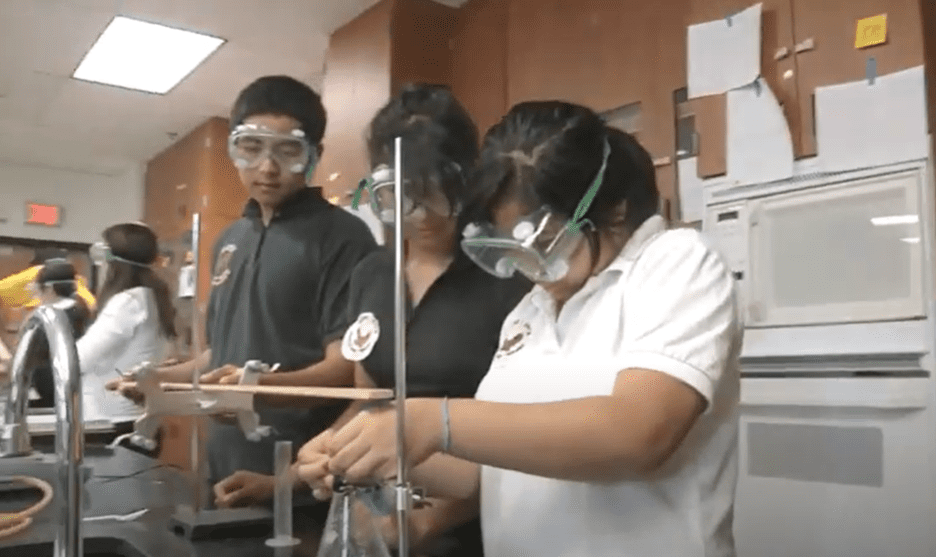
Active Chemistry® Classroom