
Activate Learning PRIME® Elementary Science
The Activate Learning PRIME elementary science curriculum provides the needed support to teachers to engage children in learning science by doing science. Students also read, write, and talk about science. PRIME promotes fundamental science concepts while incorporating core learning goals in English Language Arts standards.
PRIME was thoughtfully developed to address known challenges to teaching science in elementary classrooms, so that teachers AND students have a successful experience with science in the elementary classroom.
Available as a package or for individual purchase


Digital
On the Activate Learning Digital Platform

Kits
Materials & Supplies

Professional Learning

Phenomena-Based
Inquiry Approach
The PRIME elementary science program focuses on developing discourse and critical thinking skills alongside disciplinary content knowledge.

Students Learn Like Scientists and Engineers
PRIME utilizes science and engineering practices to help students make sense of engaging hands-on explorations.

Total Support
for Teachers
In person and online teacher support, educational webinars, lesson modeling, and much more is provided by our Professional Learning Team to help teachers AND students succeed.
Need more info to decide if this the right curriculum for your district or school?
Curriculum Details
The goals of the Activate Learning PRIME elementary science program are to preserve the curiosity and open mindedness that children bring to their environment and to link hands-on explorations in the real world with accurate science content through thinking, reflection, and discussion.
-
Students Learn Science by Doing Science
Students ask questions, explore materials, share and refine ideas, solve problems, and, ultimately, use critical thinking to make informed decisions.
-
Total Support for Teachers
PRIME Teacher Edition includes lesson plans, discussion questions, differentiation strategies, and background information for each unit, providing comprehensive support for busy classroom teachers.
-
NGSS Alignment
Download the program brochure to view the detailed NGSS alignment for the Activate Learning PRIME elementary science curriculum.
Intentional Design for Elementary Classroom Teachers
The Activate Learning PRIME elementary science curriculum was thoughtfully developed to address known challenges to teaching science in elementary classrooms, including:
1) limited science background and content knowledge of many teachers
2) minimal time for and focus on science in elementary schools
3) usability challenges inherent in a hands-on science environment
Activate Learning PRIME provides the needed support to teachers to engage children in learning science by doing science. The program’s science inquiry activities provide a real-world context for mathematics and language skill development, resulting in more confidence and higher achievement.
Elementary Science Topics
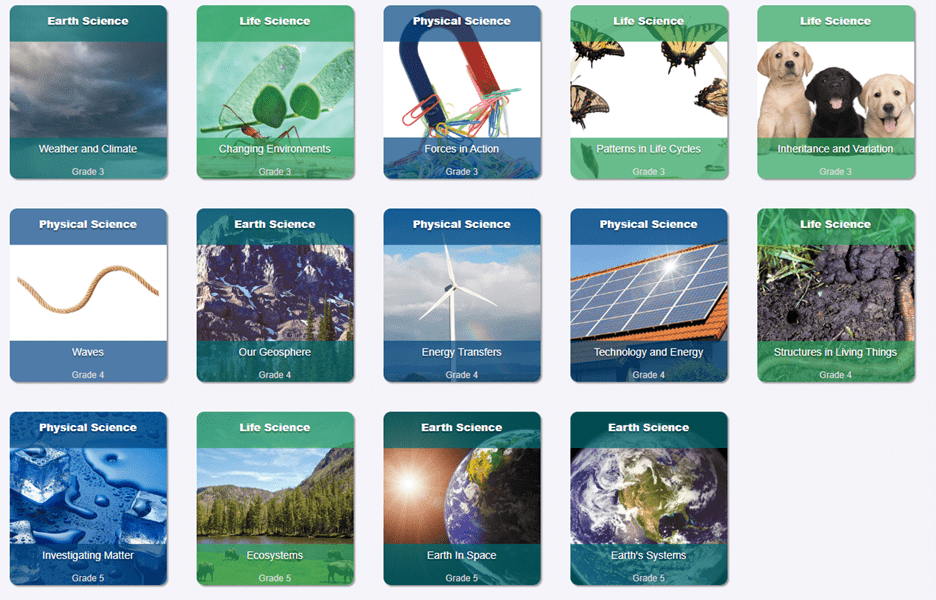
The PRIME elementary science curriculum includes 23 modular units to provide maximum flexibility, allowing districts to develop a sequence that best meets their unique needs.
Below are some example units aligned to Next Generation Science Standards by grade level. Download the program brochure to view the full list of units available in the Activate Learning PRIME elementary science program.
The Tracking the Weather topic encourages children to build on their natural sense of wonder and curiosity about the world while they:
- Make drawings of weather scenes, themselves wearing indoor and outdoor clothing, clouds and precipitation, and wind.
- Record daily weather conditions and look for patterns in the weather data during each season and over the entire year.
- Create seasonal Weather Books that contain a variety of their drawings.
- Explore severe weather such as hurricanes and tornadoes, and learn how to prepare for them to stay safe.
The Examining Living Things topic encourages children to think and work as biologists. During this topic, the children:
- Learn about what it means to be a biologist, and engage in a biologist’s practices of exploring the world.
- Discover that the structures of plants and animals are related to their functions.
- Observe and record patterns in the structures of different plants, and in the structures and behaviors of different animals.
- Appreciate that by mimicking how other living things meet their needs, humans can look to the natural world to design solutions to our problems.
- Model and create a nature-inspired solution to a human problem.
The Solids, Liquids, and Gases topic opens children’s eyes to the materials around them and the way things change. During this topic, the children:
- Learn about the properties of objects, such as size, weight, color, and texture.
- Identify the different materials that make up common objects, and think about the properties that make each material useful.
- Discover that different objects can be made from the same set of pieces.
- Identify solids, liquids, and gases in their own environment.
- Compare different materials to explore the properties that help us classify things as solids or liquids.
- Explore how water (and other things) can change from a liquid to a solid, and back to a liquid—over and over.
- Discover that some changes caused by cooling and heating are reversible, and other changes are irreversible.
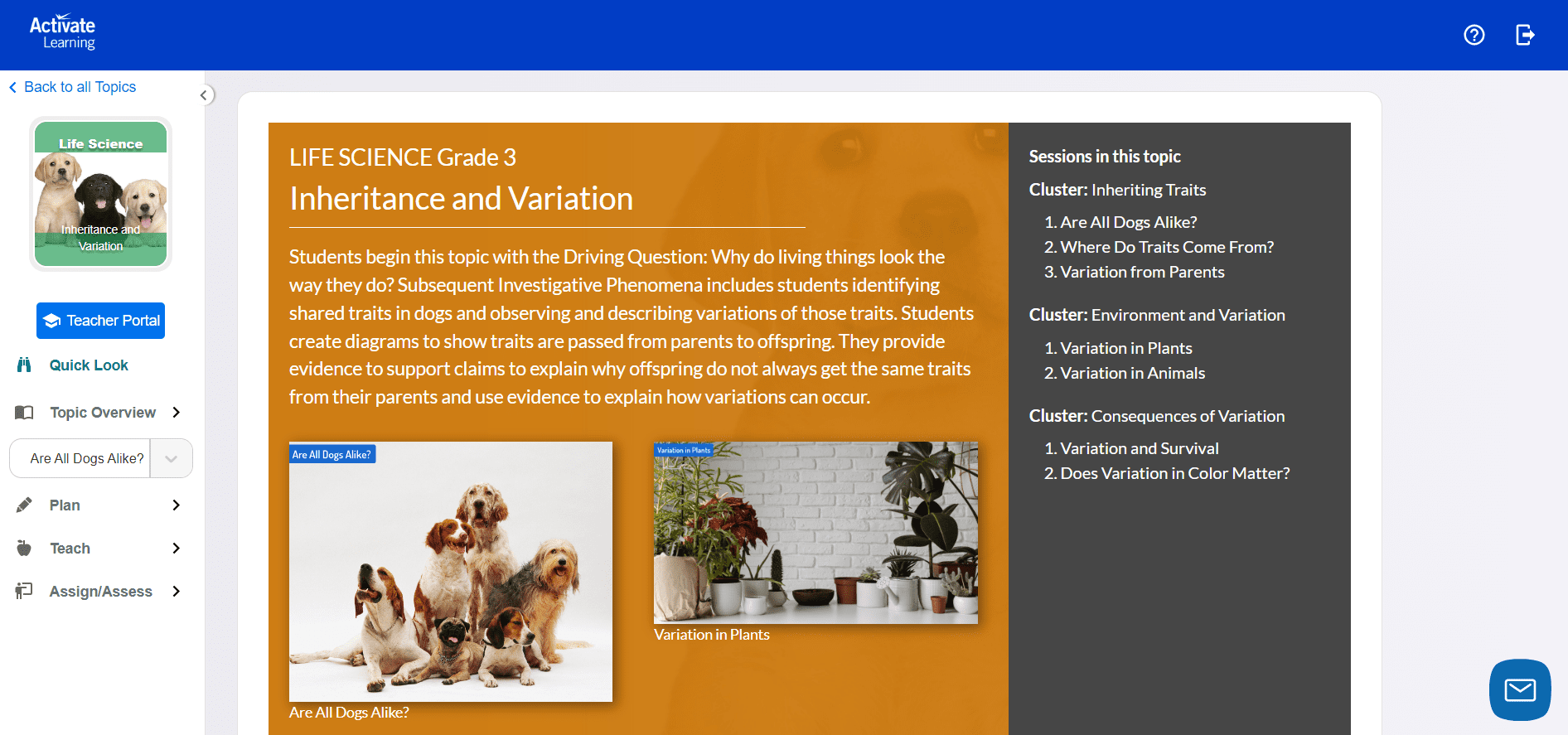
The Inheritance and Variation topic encourages children to develop a new understanding of the phenomena and processes that govern the characteristics and features of living things and impact their ability to survive in their habitat. During this topic, the children:
- Look carefully at dogs to understand what a trait is and how traits can have variations within the same kind of organism.
- Observe and describe the similarities and differences between parent animals and plants and their offspring to learn that organisms inherit traits from their parents.
- Read about the environmental influences on traits and use that information to identify the differences in offspring they observe.
- Read case studies about flamingos, frogs, and snowshoe hares and then use those to support a claim that the environment can affect animals’ traits.
- Look at how variation in traits of frogs and mice affect their ability to survive in their habitats.
- Create bar graphs to analyze data about frogs.
- Play a game where they act as predators to understand how variation in color affects survival.
The Technology and Energy topic helps students discover the wonders of electricity, other forms of energy, and the relationship of energy to making technology work. During this topic, the students:
- Try out ideas about how to light a bulb with a battery and wires.
- Recognize and use the components in a battery-bulb circuit.
- Build a circuit with a battery and motor.
- Explore conductors and insulators of electric current.
- Recognize electrical hazards and the safe use of electricity.
- Build and use light bulb holders.
- Draw circuit symbols and schematics.
- Learn about parallel and serial circuits.
- Design, build, and demonstrate a circuit that solves a problem.
- Explore different types of stored energy and fuels.
- Read about renewable and non-renewable energy and power.
- Discover how our use of energy impacts our world.
- Explore energy efficiency.
The Investigating Matter topic recognizes that to understand their world, students must have many experiences with matter. During this topic, the students:
- Define matter and identify many of its common properties.
- Become familiar with the common states of matter: solid, liquid, and gas.
- Plan and conduct an investigation to prove that air has weight.
- Conduct investigations to show that materials can be identified based on their properties.
- Show that the weight of matter doesn’t change when heated or cooled or when mixed with other substances.
- Discover the differences between physical and chemical changes.
- Plan and conduct fair tests involving chemical changes to show that the weight of matter stays the same during these changes.
- Discover how unusual mixtures have properties, unlike other materials they explore in the topic.
Elementary Science Curriculum with a Strong Literacy Focus
With the PRIME elementary science curriculum, students are not only actively doing science, but they are also reading, writing, and talking about science. PRIME promotes understanding fundamental science concepts while incorporating core learning goals in English Language Arts standards.
Science Readers
Activate Learning PRIME provides over 375 supplemental readings, incorporating at least ten readings per topic to support expository or informational text instruction and science content vocabulary development. PRIME readings include text features such as headings that can help readers locate and organize information in the text, and numbered paragraphs which allow students to quickly locate and direct others to those places where they have found relevant information.
Reading science books helps students grow their scientific vocabulary, acquire knowledge of scientific concepts, and enhance critical thinking abilities. Engaging in reading fosters language development, comprehension skills, and effective communication, which are fundamental aspects of literacy. PRIME also provides a list of high-interest and nationally recognized trade books that align with the topic to support ELA in the classroom and promote independent reading. Printable vocabulary cards are also provided to help with Word Wall construction for the identified scientific terms.
Science Notebooks
Science notebooks, whether in print or digital form, are essential in the PRIME elementary science program. They allow students to document their observations, thoughts, and data using pictures, words, and math skills. Mathematics connections are seamlessly integrated into PRIME lessons to link science topics with relevant mathematical skills. Furthermore, mathematics extensions are included at the end of many lessons, allowing for flexible implementation with individuals, small groups, or the whole class during and outside regular school hours.
Digital Platform
The Activate Learning Digital Platform (ALDP) hosts the interactive digital edition of the Activate Learning PRIME elementary science teacher and student curriculum materials.
The Activate Learning Digital platform has earned the prestigious ISTE Seal validation for high-quality education technology platforms.
The platform is designed for student safety and accessibility and offers embedded translation for 140+ languages, text-to-speech with read-along highlighting, and sentence starters to support writing.
Featuring an intuitive user experience, teachers have everything they need to Plan, Teach, Assign, and Assess lessons in a platform that is integrated with leading SIS rostering and Learning Management Systems such as Google Classroom, Schoology, and Canvas.
And with Lesson Launch, teachers can quickly view slides, handouts, student edition, and materials in one place!
PRIME® Elementary Science Developers & Contributors
A product of UChicago STEM Education, Activate Learning PRIME elementary science is the result of a rigorous iterative development process by an author team comprised of both content and classroom specialists, and is designed to be educative for elementary school teachers, as well as for students.
Activate Learning PRIME was thoughtfully developed to address known challenges to teaching science in elementary classrooms. PRIME includes built-in support for teachers so that students AND teachers can feel successful with science.
Penny Atcheson, Belinda Basca, Colleen Bell, Diane Bell, Lance Campbell, Kerry Lee Cook, Annie Holdren, Cindy Buchenroth-Martin, Lauren Satterly, Debbie Leslie, David Sherman, Martha Sullivan, Susan Taddei, and Patrick Taylor Editors Laura Lee Bennett, Rachel Burke Cusack, Wanda Gayle, and David Sherman
Jean Bell, Max Bell, Cindy Buchenroth-Martin, Nick Cabot, Catherine Grubin, David Kopp, Cathy Tietjen, Robert Ward, Toni Woodruff, Laura Arnow, Sandy Lambacher, Susan Taddei, and Joy Reynolds
Lance Campbell, Cindy Buchenroth-Martin, Kevin Sherman, Colleen Bell, and Liz Lehman
Diana Barrie, Colin Hayes, Anthony Lewis, Meg Ross, Bill Reiswig, Carolyn Loxton and MaryBeth Schulze